Objective

Humanoid architecture & dynamic actuation

Building toward a unified humanoid platform, but the proof is in metal first: systems I have fabricated, wired, debugged, and run under load before the full machine exists.

Anchor / proof

Built, tested, under load

Completed hardware from co-ops and competition: machined assemblies, shop infrastructure, and mechanisms with measurable performance. Not renders; systems that shipped to a floor or a field.

Active R&D

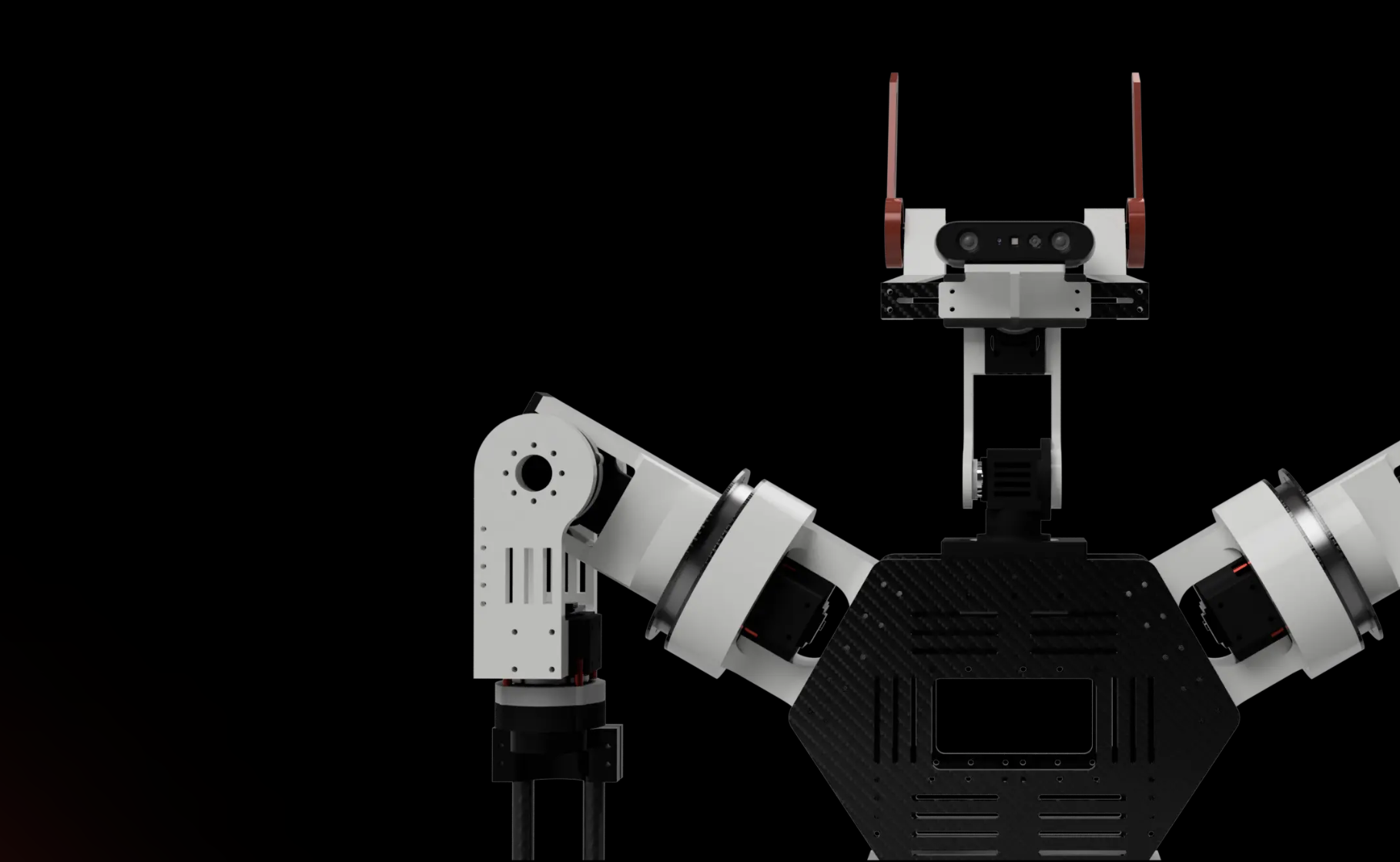
Unified humanoid platform, in development

Joint modules, limb architectures, and compute stack built on the same manufacturing discipline as the work above: FEA, gearbox simulation, bench-test plans, and tolerance stacks that must survive assembly and load.

R&D / 01

Head: compute & comms

Edge inference and motor bus orchestration: boot-handshake protocols, kernel bring-up, and low-latency sensing pipelines for closed-loop control.

  • Robstride motor synchronization and reComputer Mini cluster flashing
  • Real-time CV inference and low-compute SLAM; bench characterization ongoing
  • Latency budget from capture to torque command documented in test plan
R&D / 03

Arms: manipulation architecture

Serial 6-DOF limb design in progress: topology-optimized links, gearbox trade studies, and integration paths informed by competition-grade mechanisms already built and raced.

6-DOF QDD manipulator

Humanoid arm architecture study
  • ~20% mass reduction via generative topology optimization
  • Planetary vs. harmonic integration: stiffness and backlash budgets
  • Target: OTS-cost fraction with in-house manufacturable linkages
Arm architecture study

Proven manipulation baseline

Competition mechanisms that set the reliability bar for end-effector and transmission design.

  • Dual-speed shifters and elastomer intakes, field-proven at Worlds
  • GD&T and DFM learned under match-cycle pressure
VEXU physical systems →
R&D / 04

Legs: locomotion & validation

Sim-to-real policy work paired with HIL rigs from prior co-op work. Gait dynamics in simulation, failure modes caught on hardware before they reach a humanoid stack.

Sim-to-real RL

  • PPO in NVIDIA Isaac Gym: multi-phase curriculum with hip-yaw dynamics
  • Domain randomization: friction, mass, sensor noise on digital twin
  • Bench-test plan defined for policy → torque command handoff

Validation infrastructure

Physical test philosophy carried forward from Trexo co-op work.

  • Gait and load-path rigs: cycle life and thermal dissipation metrics
  • Automated HIL fixtures for pre-deployment sign-off
Trexo validation systems →

Contact

Reach out for humanoid hardware development, structural optimization, or robotics chat.

justin.an@uwaterloo.ca